



What if my W2 inaccurately reports vested RSU income? Your Expert Guide to Correction
For over two decades in the finance and tax world, I've witnessed the quiet panic that sets in when employees, especially those with equity compensation, discover a glaring discrepancy on their W2. It’s a common, yet deeply frustrating, scenario: your W2 arrives, and a quick glance suggests something is off with your vested Restricted Stock Unit (RSU) income. This isn't just a minor administrative glitch; it can have significant implications for your tax liability, potentially leading to overpayment, underpayment, or even an audit.
The complexity of RSU taxation, coupled with the often-misunderstood process of withholding and reporting, creates a fertile ground for errors. Many assume their employer's payroll system, or their brokerage, has everything perfectly aligned. Unfortunately, that's not always the case, and the burden of ensuring accuracy ultimately falls on you, the taxpayer. The pain point is real: fear of IRS scrutiny, the hassle of corrections, and the potential financial hit.
This comprehensive guide will equip you with the knowledge, actionable steps, and expert insights needed to confidently address an inaccurate W2 reporting vested RSU income. We'll delve into understanding RSU taxation, identifying discrepancies, navigating the correction process with your employer, and ensuring your tax return accurately reflects your true income. My goal is to empower you to not just fix this immediate problem, but to prevent future occurrences and gain peace of mind in your financial planning.
Understanding RSU Taxation: The Basics You Need to Know
Before we can fix an error, we must first understand how RSUs are supposed to be taxed. This is often where the initial confusion, and subsequent reporting errors, begin. RSUs are a form of equity compensation that companies grant to employees, typically vesting over a period of years.
Vesting vs. Sale: Different Tax Triggers
The critical distinction with RSUs lies in their taxability at two distinct points:
- Vesting Event: When your RSUs vest, they are no longer restricted. At this point, the fair market value (FMV) of the shares on the vesting date is considered ordinary income. This income is subject to federal income tax, Social Security, Medicare, and often state income tax. Your employer is required to withhold taxes on this income, typically by selling a portion of the vested shares or withholding from your salary. This amount should be reported on your W2.
- Sale Event: If you sell the shares after they have vested, any gain or loss from the vesting date's FMV to the sale date's FMV is considered a capital gain or loss. This is reported on Form 1099-B from your brokerage, not on your W2. The holding period (short-term or long-term) for capital gains begins on the vesting date.
How Withholding Works (or Fails) with RSUs
When RSUs vest, your employer typically withholds a percentage of the shares or cash to cover the tax obligations. This withheld amount should then be remitted to the relevant tax authorities and reflected on your W2. Common withholding methods include:
- Sell-to-Cover: A portion of the vested shares are immediately sold to cover the tax withholding.
- Net Share Issuance: Fewer shares are issued to you, with the value of the 'missing' shares covering the tax.
- Cash Withholding: Taxes are withheld from your regular paycheck to cover the RSU vesting tax.
I've seen this mistake countless times: many individuals confuse the value of their vested shares with the net shares they receive after withholding. The taxable income is the *gross* value of the shares at vesting, before any taxes are taken out. This gross amount is what your W2 should reflect as ordinary income. Any error here can lead to a significant misstatement of your taxable income.
The Red Flags: Identifying an Inaccurate W2 for RSU Income
Your W2 is a summary of your annual earnings and withholdings. When it comes to RSUs, several boxes are key. Knowing what to look for is the first step in identifying an inaccuracy. In my experience, these are the most common areas where RSU reporting goes awry.
Common Discrepancies and Where to Look
- Box 1 (Wages, Tips, Other Compensation): This box should include the fair market value of your vested RSUs on the vesting date. If this amount seems too low (e.g., only the net shares were reported) or too high, it's a major red flag.
- Box 3 (Social Security Wages) & Box 5 (Medicare Wages): RSU income is generally subject to Social Security and Medicare taxes up to the annual limits. These boxes should also include the RSU income.
- Box 12 (Codes V, W, Z, or other): This is where the employer usually reports the value of non-qualified deferred compensation, including vested RSUs. Code V, for example, is specifically for income from the exercise of nonstatutory stock options, but some companies might use other codes or a general description if they don't have a specific RSU code. The amount here should generally align with the RSU income included in Box 1.
- State and Local Wages/Taxes (Boxes 16-20): Ensure RSU income is correctly reported and taxed according to your state and local tax laws, especially if you moved states during the year.
You can't rely solely on your W2. You need to cross-reference it with other critical documents:
- Brokerage Statements: Your year-end brokerage statement will detail all RSU vestings and sales. Specifically, look for a 'Statement of Stock Option and RSU Activity' or similar. This will show the vesting date, number of shares, and FMV at vesting.
- Company Equity Portal/HR Records: Your company's internal equity platform (e.g., Fidelity, E*TRADE, Schwab) will have a detailed history of your RSU grants, vesting schedules, and actual vesting transactions.
- Pay Stubs: Your final pay stub for the year, or a summary year-to-date earnings statement, should show the cumulative RSU income and associated withholdings.
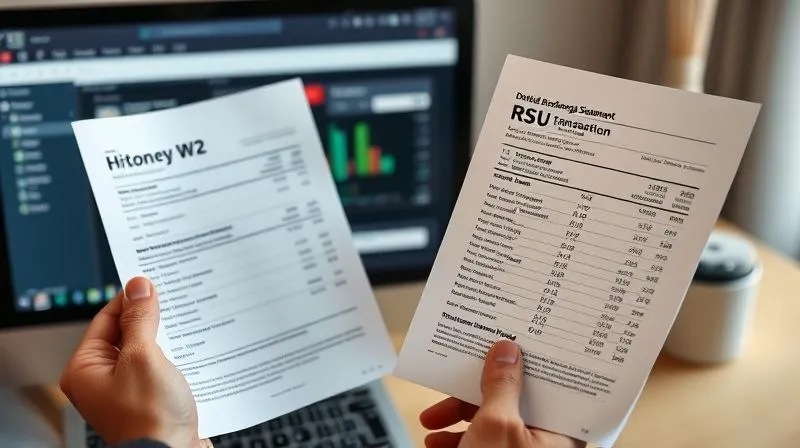
Step-by-Step: Reconciling Your RSU Income Data
Reconciling your RSU income is a methodical process. It requires diligence and attention to detail. Don't rush this; a thorough reconciliation is your best defense against future tax issues. This is where my experience truly comes into play – I've guided countless clients through this exact process.
- Step 1: Gather All Relevant Documents.
Collect every piece of paper (or digital file) related to your RSU income for the tax year in question. This includes your W2, all pay stubs, your year-end brokerage statements (especially Form 1099-B if you sold shares, and any RSU activity statements), and access to your company's equity platform or HR portal for vesting details.
- Step 2: Compare Your W2 to Brokerage Statements.
Identify all RSU vesting events that occurred during the tax year from your brokerage statement. For each vesting event, note the date, the number of shares vested, and the Fair Market Value (FMV) per share on the vesting date. Multiply the number of shares by the FMV per share to get the total gross income for each vesting event. Sum these gross amounts to get your total RSU ordinary income for the year.
Now, compare this total gross RSU income to the amount reported in Box 1 of your W2. Also, check Box 12 (if applicable) for RSU-related codes. If there's a significant difference, you've found a discrepancy. Pay close attention to the withholding amounts reported on your brokerage statements (e.g., shares sold for tax) and ensure they align with the federal, state, and local taxes withheld on your W2.
- Step 3: Analyze Withholding Details on Pay Stubs.
Review your pay stubs, particularly those around the RSU vesting dates. Sometimes, the RSU income and associated withholdings are reported as a separate line item on your pay stub. Confirm that the total federal, state, and local taxes withheld on your pay stubs (including any RSU-related withholdings) reconcile with the amounts reported in Boxes 2, 17, and 19 of your W2.
| Document | Reported Value |
|---|---|
| W2 - Box 1 | $X,XXX |
| W2 - Box 12 (V or other) | $Y,YYY |
| Brokerage Statement - Total Gross RSU Vesting Income | $Z,ZZZ |
| Brokerage Statement - Federal Withholding | $A,AAA |
| W2 - Box 2 (Federal Income Tax Withheld) | $B,BBB |
| Pay Stubs - Year-to-Date Federal Withholding | $C,CCC |
When to Act: Correcting Your W2 with Your Employer
Once you've identified a clear discrepancy, the next crucial step is to engage with your employer. This process can sometimes feel daunting, but approaching it systematically and professionally will yield the best results. Remember, your employer has a legal obligation to provide an accurate W2.
The W-2c Process: Requesting a Corrected Statement
If your W2 is incorrect, your employer must issue a corrected W2, known as a Form W-2c, Corrected Wage and Tax Statement. This form corrects errors on a previously filed W2. Here's how to initiate the process:
- Prepare Your Evidence: Compile all your reconciliation findings. Clearly highlight the discrepancies between your W2 and your supporting documents (brokerage statements, equity portal data, calculations). Be specific about the incorrect amounts in each W2 box.
- Contact Your Payroll or HR Department: This is your first point of contact. Explain the situation calmly and professionally. State that you believe there's an error in your RSU income reporting on your W2 and provide your detailed findings.
- Request a W-2c: Explicitly ask for a corrected W2 (Form W-2c) to be issued. Be prepared to provide copies of your supporting documentation.
- Follow Up: Payroll departments can be busy, especially during tax season. If you don't hear back within a reasonable timeframe (e.g., 1-2 weeks), follow up politely. Document all communications, including dates, names of people you spoke with, and summaries of discussions.
Navigating HR and Payroll: What to Expect
Be patient but persistent. Some companies have robust processes for W-2c requests, while others might be less familiar with RSU-specific corrections. You might encounter:
- Initial Resistance: Some payroll staff might initially be skeptical or unfamiliar with the nuances of RSU reporting. Be ready to explain clearly.
- Investigation Period: Your employer will need time to investigate your claim, reconcile their own records, and potentially coordinate with their equity plan administrator or brokerage.
- Timelines: Issuing a W-2c can take several weeks, especially if the error is complex or involves multiple departments. Plan accordingly, particularly if the tax filing deadline is approaching.
Proactivity is paramount here. The sooner you identify and report the error, the more time your employer has to correct it before the tax filing deadline. Waiting until the last minute can add significant stress and complicate your filing strategy.

Filing Your Taxes with Inaccurate W2 Data: What Are Your Options?
What if the tax deadline looms, and you still haven't received a corrected W-2c? You have options, but they require careful consideration to avoid future issues with the IRS. As an expert, I always advise against simply guessing or ignoring the problem.
Option 1: File an Amended Return (Form 1040-X)
If you receive your W-2c *after* you've already filed your original tax return, you will need to file an amended tax return using Form 1040-X. This is a common scenario. You'll enter the corrected figures from your W-2c on Form 1040-X, explain the changes, and recalculate your tax liability. If the correction leads to a refund, the IRS will issue it. If it leads to additional tax due, you'll need to pay it to avoid penalties and interest.
Option 2: Attach an Explanation (Form 8275)
If you cannot get a W-2c from your employer before the tax deadline, and you are confident in your own reconciliation, you can file your original return using your reconciled figures. However, you MUST attach Form 8275, Disclosure Statement, to your tax return. On this form, you explain the discrepancy, state that you've attempted to get a W-2c, and provide the correct figures. This informs the IRS that your filed return differs from the W2 they received from your employer and provides your justification. This is a more aggressive approach and should only be taken if you are absolutely certain of your figures and have documented all attempts to get a W-2c.
The 'Do Nothing' Trap: Why It's a Bad Idea
Resist the urge to simply 'hope for the best' or 'ignore it.' The IRS receives copies of your W2 from your employer. If your filed tax return doesn't match the information on record, it will likely trigger an IRS inquiry or audit. This can lead to:
- Notices (CP2000, etc.) requiring you to explain discrepancies.
- Assessment of additional tax, penalties, and interest.
- Significant stress and time spent resolving the issue.
Case Study: Sarah's RSU Reporting Nightmare and Resolution
Let me share a real-world (though anonymized) example to illustrate how this plays out and the importance of proactive action. This is a situation I've guided clients through multiple times.
Sarah's Situation: Discrepancy Identified
Sarah, a software engineer at a rapidly growing tech company, received her W2. She had two RSU vesting events during the year. Upon reviewing her W2, she noticed that the amount in Box 1 seemed lower than expected, and the RSU income amount in Box 12 (Code V) was also off. Her brokerage statements showed a total gross RSU vesting income of $150,000, but her W2 only reported $130,000 in Box 1 and Box 12. A $20,000 discrepancy.
Sarah's immediate concern was that she might be underreporting income, which could lead to IRS penalties. She meticulously gathered her W2, all her pay stubs, and her detailed RSU vesting statements from her brokerage account.
Her Actions: Following the Reconciliation Steps
Following a process similar to what I've outlined above, Sarah:
- Calculated the gross fair market value of her vested RSUs on each vesting date, totaling $150,000.
- Compared this to her W2 and confirmed the $20,000 shortfall in Box 1 and Box 12.
- Examined her pay stubs, which showed that while her regular salary withholdings were correct, the RSU vesting events seemed to have been processed with an incorrect 'cost basis' or a misunderstanding of the gross vs. net taxable amount by her payroll provider.
- She then drafted a professional email to her HR and payroll department, attaching her detailed calculations and the relevant sections of her brokerage statements. She clearly stated the discrepancy and formally requested a W-2c.
The Outcome: Corrected W2 and Peace of Mind
Sarah faced some initial back-and-forth with her payroll department, who initially insisted their records were correct. However, because Sarah provided clear, documented evidence from her brokerage and her own calculations, they escalated the issue. After two weeks, her employer acknowledged the error, which stemmed from a miscommunication between their equity plan administrator and payroll system regarding the gross vesting value.
Within three weeks, Sarah received a corrected W-2c showing the accurate $150,000 in Box 1 and Box 12. She was able to file her tax return correctly and on time, avoiding any potential IRS inquiries or penalties. This experience not only saved her potential headaches but also gave her a deeper understanding of her equity compensation.

Beyond the W2: Preventing Future RSU Reporting Errors
An ounce of prevention is worth a pound of cure, especially in tax matters. While you can't control your employer's systems entirely, you can adopt proactive habits to minimize the risk of future RSU reporting errors and catch them early if they do occur. This is about building financial literacy and diligence.
Proactive Monitoring Tips
- Review Every Vesting Statement: After each RSU vesting event, immediately review the confirmation statement from your brokerage. Ensure the number of shares, vesting date, and fair market value are correct.
- Check Pay Stubs Post-Vesting: Look at your pay stub immediately following a vesting event. Confirm that the 'year-to-date' RSU income and associated tax withholdings are tracking correctly.
- Annual Reconciliation (Early): Don't wait for your W2 to arrive in January. In December, or as soon as year-end data is available on your equity portal, perform a preliminary reconciliation of your RSU income and estimated withholdings. This gives you a head start.
- Understand Your Company's Process: Ask your HR or payroll department about their specific process for reporting RSU income and withholding taxes. Knowledge is power.
Understanding Your Company's RSU Administration
Different companies, and even different equity administrators, can have slightly varied reporting mechanisms. For instance, some might report the 'net' shares as income in Box 1, while others correctly report the 'gross' value. Understanding your employer's specific approach can help you anticipate potential issues. As marketing guru Seth Godin often says, "The market doesn't care about your stories, it cares about its stories." Similarly, the IRS cares about the numbers, so ensure your understanding aligns with the correct tax treatment, not just your company's internal process.
The Value of a Tax Professional
For complex RSU situations, especially if you have multiple grants, moved states, or have other complicated tax scenarios (e.g., non-resident alien status), consulting a qualified tax professional is invaluable. They can help you:
- Navigate complex RSU reporting rules.
- Ensure accurate reconciliation.
- Advise on the best filing strategy if a W-2c isn't available.
- Identify opportunities for tax optimization related to your equity compensation.
According to a recent survey by the National Association of Tax Professionals, errors related to equity compensation are among the top five most common reasons individuals seek professional tax advice.
| Action | Frequency |
|---|---|
| Review Vesting Statements | Immediately after each vesting |
| Check Pay Stubs | After each vesting, for YTD figures |
| Preliminary Annual Reconciliation | December / Early January |
| Understand Company RSU Process | Annually or upon grant |
| Consult Tax Professional | If complex, or when in doubt |
Frequently Asked Questions (FAQ)
Q: Can I just ignore a small discrepancy on my W2? No, ignoring any discrepancy, regardless of size, is ill-advised. Even small errors can compound over time or trigger IRS scrutiny. It's always best to reconcile and correct any inaccuracies to ensure your tax return is fully compliant. While the IRS might not pursue every minor error, you don't want to leave it to chance, especially when it involves income.
Q: What if my employer refuses to issue a W-2c? If, after repeated attempts and providing clear evidence, your employer still refuses to issue a W-2c, you have recourse. You can contact the IRS directly by calling their toll-free number. The IRS can intervene and contact your employer on your behalf. Additionally, you should file your return with your best estimate of the correct income and attach Form 8275, Disclosure Statement, explaining the situation and your attempts to get a corrected W2.
Q: How does this affect state taxes? RSU income is generally subject to state income tax in the state where you were employed when the RSUs vested. If your W2 inaccurately reports RSU income, it will likely affect your state wages and state tax withheld as well. You'll need to ensure your W-2c corrects both federal and state figures. If you lived or worked in multiple states during the year, the allocation of RSU income for state tax purposes can become even more complex, often requiring professional guidance.
Q: What's the deadline for fixing this? Ideally, you want to resolve the W2 error and receive a W-2c before the federal tax filing deadline (typically April 15th). If you can't, you'll need to decide whether to file with Form 8275 or file an extension and wait for the W-2c, then file your original return. If you've already filed and then receive a W-2c, you have three years from the date you filed your original return or two years from the date you paid the tax (whichever is later) to file an amended return (Form 1040-X).
Q: Does this impact my eligibility for tax credits or deductions? Absolutely. Your Adjusted Gross Income (AGI), which is directly affected by your reported W2 income, is a critical factor in determining eligibility for many tax credits and deductions. An inaccurately reported RSU income could push your AGI higher or lower, potentially affecting your eligibility for things like the Child Tax Credit, education credits, or even the deductibility of certain expenses. Correcting your W2 ensures your AGI is accurate, which is fundamental for proper tax planning.
Key Takeaways and Final Thoughts
Dealing with an inaccurate W2, particularly concerning complex income like vested RSUs, can feel overwhelming. However, armed with the right knowledge and a systematic approach, it's a problem that is entirely solvable. My hope is that this guide has demystified the process and empowered you to take control of your tax situation.
- Understand RSU Taxation: Know the difference between vesting and sale and how each is taxed.
- Reconcile Diligently: Use your W2, brokerage statements, and pay stubs to cross-reference and identify discrepancies.
- Communicate Proactively: Engage your employer's HR and payroll departments early and with clear, documented evidence.
- Know Your Filing Options: Be prepared to file an amended return (1040-X) or attach an explanation (8275) if a W-2c isn't timely.
- Prevent Future Errors: Adopt proactive monitoring habits and consider professional advice for complex situations.
Your financial well-being hinges on accurate reporting. Don't let an employer's mistake become your tax burden. By following these steps, you not only correct a past error but also build a stronger foundation for managing your equity compensation and ensuring your tax filings are precise and compliant. Take action, stay informed, and secure your financial peace of mind.
Recommended Reading
- Unlock Crypto Tax Clarity: Can Tax Software Handle Crypto Transactions Effectively?
- Unlock Your Future: The Ultimate Guide to Building Basic Financial Literacy Skills
- 7 Legal Ways High-Earners Slash Taxes on Passive Income
- Unlock Your Financial Fortress: How to Secure Mobile Banking on Android
- 7 Smart Strategies: How Professionals Find Budget Destinations with Genuine Value





Comments
Leave a comment below. Your email will not be published. Required fields marked with *