



The Entrepreneur's Ultimate Exit Strategy Blueprint
For over two decades in the dynamic world of entrepreneurial finance, I've had a front-row seat to countless business journeys. I've witnessed incredible triumphs, heartbreaking failures, and everything in between. One consistent thread I've observed in the most successful ventures isn't just about launching strong, but about planning an equally strong finish – a well-defined exit strategy.
The harsh reality is that many entrepreneurs pour their heart and soul into building something extraordinary, only to neglect the crucial 'how' and 'when' of stepping away. This oversight can lead to a significant loss of personal wealth, unfulfilled potential for the business, and even profound personal regret. It's a problem I've seen play out far too often, leaving founders feeling trapped or undervalued.
In this definitive guide, I'll share the frameworks, insights, and actionable steps I've developed and refined over the years to help you craft a robust exit strategy. We'll explore everything from maximizing your business's value to navigating the emotional complexities of transition, ensuring you achieve not just financial freedom, but true entrepreneurial legacy and peace of mind.
Why an Exit Strategy Isn't Optional: It's Foundational
Many entrepreneurs, especially in the early stages, focus intensely on growth, market penetration, and product development. And rightly so – these are critical for survival. However, neglecting the end game, the exit strategy, is akin to building a magnificent skyscraper without an emergency exit plan or a clear understanding of its eventual sale value. It's a fundamental flaw that can undermine all your hard work.
The Cost of Neglect
Without a clear exit strategy, businesses often stagnate, become overly dependent on the founder, and struggle to attract serious buyers or investors. I've seen companies that were otherwise thriving suddenly hit a wall because the founder faced burnout, health issues, or simply a desire for a new chapter, with no clear path forward for the business. This often results in a distressed sale, undervaluation, or even liquidation, wiping out years of effort and potential wealth.
"The best time to think about your exit strategy is before you even launch your business. The second best time is now." - An experienced mentor once shared this with me, and its truth resonates in every deal I've advised on.
Moreover, a well-articulated exit strategy signals to potential investors, employees, and even customers that your business is stable, forward-thinking, and has a clear vision for its future, regardless of who is at the helm. It builds trust and demonstrates maturity.
Phase 1: Self-Assessment and Vision Casting
Before you can even begin to think about the mechanics of an exit, you must first look inward. This phase is about understanding your personal goals, financial needs, and what you truly want the next chapter of your life to look like.
- Define Your 'Why': Why do you want to exit? Is it retirement, a new venture, health, or simply a desire for a different lifestyle? Understanding your core motivation will guide every subsequent decision.
- Set Your Financial Targets: How much money do you need from the sale to achieve your post-exit goals? Be realistic, but also aspirational. Work with a financial planner to determine a concrete number.
- Timeline Realism: When do you ideally want to exit? This isn't just a date; it's a strategic timeframe. A 1-year exit plan looks vastly different from a 5-year plan, impacting how you prepare the business.
- Post-Exit Vision: What will you do after you exit? Having a compelling vision for your next chapter, whether it's travel, philanthropy, or another startup, makes the transition smoother and more appealing.
This introspection is not a one-time exercise. It should be revisited regularly as your personal circumstances and market conditions evolve. It's the anchor for your entire exit strategy process.

Phase 2: Maximizing Business Value - The Core Work
Once you know your personal goals, the next critical step is to make your business as attractive and valuable as possible to a potential buyer. This isn't just about increasing revenue; it's about building a robust, defensible, and scalable enterprise that can thrive without you.
Operational Excellence & Scalability
Buyers are looking for systems, not just sales. Can your business run efficiently without your constant intervention? Documented processes, strong management teams, and clear operational procedures significantly enhance value. Invest in automation and delegate effectively. As reported by Harvard Business Review, businesses with strong operational frameworks are consistently valued higher.
Financial Health & Transparency
Clean, audited financials are non-negotiable. Buyers will scrutinize every ledger entry. Ensure your revenue streams are diversified, profit margins are healthy, and expenses are well-managed. Any 'dirty' books or inconsistent reporting will raise red flags and potentially derail a deal or drastically reduce your valuation.
Intellectual Property & Defensibility
What makes your business unique? Patents, trademarks, proprietary software, unique methodologies, or strong brand equity are powerful value drivers. These assets create barriers to entry for competitors and provide a clear competitive advantage that buyers are willing to pay a premium for.
Consider the following comparison of two hypothetical businesses:
| Attribute | Business A (High Value) | Business B (Low Value) |
|---|---|---|
| Proprietary Tech | Patented software, custom algorithms | Off-the-shelf solutions, manual processes |
| Customer Concentration | Diversified across 100s of clients | 80% revenue from 1 key client |
| Management Team | Strong, independent leadership | Founder-dependent, high turnover |
| Recurring Revenue | 70% subscription-based | Project-based, inconsistent |
Phase 3: Exploring Your Exit Avenues
There isn't a one-size-fits-all exit strategy. Your choice will depend on your personal goals, the state of your business, and market conditions. Understanding the various options is crucial.
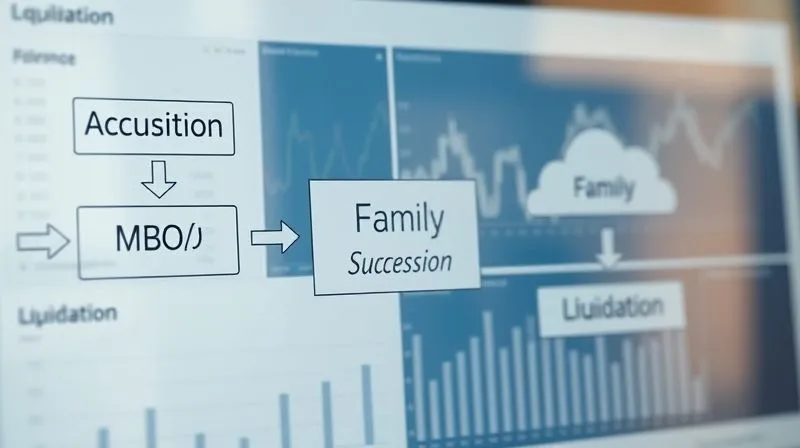
The Acquisition Route (M&A)
This is often the most lucrative path, involving selling your business to a larger company, a competitor, or a private equity firm. Buyers are typically looking for strategic synergies, market share, technology, or talent. This requires significant preparation, due diligence, and negotiation.
Management Buyout (MBO) or Employee Stock Ownership Plans (ESOP)
If you want to ensure the legacy of your business and reward your loyal team, an MBO or ESOP might be ideal. In an MBO, your existing management team buys you out. An ESOP allows employees to gradually acquire ownership. These options can be complex financially but offer a smooth transition and preserve culture.
Family Succession
For many family businesses, passing the torch to the next generation is the preferred exit. This requires careful planning around leadership development, legal structures, and often, managing family dynamics. It's not just a business transaction; it's a legacy transfer.
Liquidation (The Last Resort)
In some unfortunate scenarios, such as declining markets or insurmountable debt, liquidation might be the only option. This involves selling off assets to pay creditors. While often painful, a planned liquidation can still be managed to minimize losses and provide a clean break, rather than a forced, chaotic one.
Phase 4: Building Your A-Team for the Transition
You wouldn't build a house without an architect, and you shouldn't navigate an exit without a team of expert advisors. This is where your personal experience meets specialized expertise.
The Role of Advisors
I've seen firsthand how a strong advisory team can increase your sale price and prevent costly mistakes. Your team should typically include:
- M&A Advisor/Business Broker: They understand the market, can identify potential buyers, and manage the sale process.
- Corporate Attorney: Essential for drafting and reviewing legal documents, ensuring compliance, and protecting your interests.
- CPA/Tax Advisor: Crucial for structuring the deal in a tax-efficient manner, minimizing your tax burden.
- Financial Planner: To help you plan for your post-exit financial future and integrate the sale proceeds into your overall wealth management strategy.
- Personal Coach/Therapist: Don't underestimate the emotional toll of selling your life's work. A coach can help you navigate this transition.
"Trying to sell your business without expert guidance is like performing surgery on yourself. You might save some money upfront, but the risks are astronomical." - This analogy perfectly captures the importance of a professional team.
Case Study: How 'InnovateCo' Engineered a Smooth Exit
The Challenge
InnovateCo, a rapidly growing SaaS company in the niche market of small business analytics, had achieved significant traction. However, its founder, Sarah, felt increasingly burnt out after 12 years at the helm. She wanted to exit within three years to pursue philanthropic work but knew the business was heavily reliant on her personal network and vision.
The Strategy Implemented
Sarah engaged an M&A advisor early. Together, they developed a three-year exit strategy. The key steps included:
- Delegation and Empowerment: Sarah systematically delegated key client relationships and product development responsibilities to her senior management team, instituting robust reporting and decision-making frameworks.
- Process Documentation: Every critical business process, from customer onboarding to sales funnels, was meticulously documented and optimized, reducing reliance on tribal knowledge.
- Financial Clean-up: With her CPA, Sarah streamlined InnovateCo's financials, ensuring all revenue was clearly categorized, expenses were justified, and projections were conservative and defensible.
- Strategic Marketing for Acquisition: The M&A advisor helped position InnovateCo as an attractive acquisition target for larger tech firms seeking to expand into the small business analytics space, highlighting its recurring revenue model and patented data analysis technology.
The Outcome
After two and a half years of diligent preparation, InnovateCo received multiple acquisition offers. Sarah ultimately sold the company for 15x EBITDA to a major tech conglomerate, significantly exceeding her initial financial targets. The transition was smooth, with her management team largely retained, ensuring business continuity. Sarah successfully transitioned to lead a non-profit, feeling fulfilled and financially secure. This case highlights how proactive planning can transform a potential struggle into a resounding success. You can read more about successful transitions on resources like Forbes Business section.
Phase 5: Valuation and Negotiation - Getting What You Deserve
Understanding your business's true worth and effectively negotiating its sale are pivotal steps in your exit strategy. This is where all your preparation culminates.
Understanding Business Valuation Methods
There are several ways to value a business, and often a combination is used:
- Asset-Based Valuation: Sums up the fair market value of all tangible and intangible assets.
- Income-Based Valuation (e.g., DCF): Projects future cash flows and discounts them back to a present value.
- Market-Based Valuation (e.g., Multiples): Compares your business to recently sold similar companies (multiples of revenue, EBITDA, etc.).
I always advise clients to have their business professionally valued by a qualified expert. This provides a baseline for negotiation and helps you understand buyer expectations.
The Art of Negotiation
Negotiation isn't just about price. It involves terms, conditions, earn-outs, transition periods, and employee retention. Be prepared for multiple rounds of offers and counter-offers. Your advisory team will be invaluable here, helping you stay objective and focused on your ultimate goals. Remember, the highest price isn't always the best deal if the terms are unfavorable or risky.
Here's a simplified look at how valuation metrics can influence the perceived value:
| Metric | Early Stage (High Growth) | Mature (Stable Growth) |
|---|---|---|
| EBITDA Multiple | 6x-10x | 3x-6x |
| Revenue Multiple | 4x-8x | 0.5x-2x |
| Customer Churn Rate | Higher Valuation | Lower Valuation |
| Founder Dependency | Higher Valuation | Lower Valuation |
Phase 6: Legal & Financial Due Diligence
This is arguably the most intense phase of any exit strategy. Once a letter of intent (LOI) is signed, the buyer will conduct thorough due diligence, scrutinizing every aspect of your business.
Preparing for Scrutiny
Your goal here is to be prepared and transparent. Any skeletons in the closet will be found, and it's always better to disclose and address issues proactively than to have them discovered by the buyer. Key areas of due diligence include:
- Financial Due Diligence: Deep dive into all financial records, tax returns, projections, and liabilities.
- Legal Due Diligence: Review of contracts (customer, vendor, employee), intellectual property, litigation history, and regulatory compliance.
- Operational Due Diligence: Assessment of your processes, supply chain, technology infrastructure, and management team.
- Human Resources Due Diligence: Examination of employee contracts, benefits, compensation, and any HR-related issues.
A well-organized data room (physical or virtual) containing all relevant documents will significantly streamline this process and demonstrate your professionalism. Delays or missing information can kill a deal. For further insights on due diligence, official resources like Deloitte's M&A insights are invaluable.
Phase 7: Post-Exit Life - What's Next?
The successful execution of your exit strategy isn't the finish line; it's a new starting line. Many founders underestimate the emotional and practical adjustments required after selling their business.
Financial Planning for the Future
With a significant capital event, your financial landscape will change dramatically. Work closely with your financial planner to optimize your investments, manage taxes, and ensure your newfound wealth supports your long-term goals. This is about building a legacy, not just making a sale.
Personal Fulfillment & New Ventures
I've seen entrepreneurs struggle with a sense of loss or lack of purpose after selling their business. Proactively plan for this transition. What new passions will you pursue? Will you mentor other entrepreneurs, invest in new startups, or finally write that book? Having a clear vision for your post-exit life is just as important as the exit itself.
Frequently Asked Questions (FAQ)
When is the best time to start planning my exit strategy? The absolute best time is before you even launch your business, as it shapes how you build and scale. The second best time is right now. The sooner you start, the more control you'll have over the process and the higher the potential value you can achieve. Proactive planning allows for strategic value creation over time.
What if I don't want to sell my business, but simply want to step back? That's a valid form of exit strategy! It often falls under succession planning or a management buyout (MBO). The focus shifts to building a strong, independent leadership team and robust systems so the business can thrive without your daily involvement. This still requires significant preparation to ensure continuity and value preservation.
How much does it cost to prepare for an exit? The costs can vary significantly depending on the complexity of your business and the advisors you engage. Expect fees for M&A advisors (often a percentage of the sale), legal counsel, accounting services, and potentially valuation experts. While these can seem substantial, they are an investment that typically yields a significantly higher sale price and a smoother process, far outweighing the initial outlay.
Can I still run my business actively while preparing for an exit? Absolutely, and in fact, you must. A thriving, growing business is always more attractive to buyers. While you'll need to dedicate time to the exit preparation process, it shouldn't detract from your core business operations. This is where effective delegation and having a strong management team become crucial.
What are the biggest mistakes entrepreneurs make with their exit strategy? Neglecting to plan early, over-reliance on the founder, poor financial records, an unrealistic valuation, and failing to assemble a professional advisory team are among the most common and costly mistakes. Underestimating the emotional toll of the exit is also a significant pitfall.
Key Takeaways and Final Thoughts
Crafting a successful exit strategy is not merely a transaction; it's a strategic culmination of your entrepreneurial journey. It demands foresight, discipline, and the wisdom to seek expert guidance. By following the seven phases I've outlined, you're not just preparing to sell a business; you're building a stronger, more resilient company and securing your personal and financial future.
- Start planning early – ideally years in advance.
- Focus relentlessly on maximizing your business's intrinsic value.
- Understand the diverse exit avenues available to you.
- Assemble a trusted team of expert advisors.
- Prepare meticulously for due diligence and negotiation.
- Plan for your life after the exit, both financially and personally.
Remember, your business is a testament to your vision and hard work. Ensuring its successful transition allows you to reap the rewards of your dedication and embark on your next chapter with confidence and freedom. Don't leave your legacy to chance; engineer your exit with precision and purpose. For additional resources and mentorship, consider exploring entrepreneurial communities and resources like Entrepreneur.com.
Recommended Reading
- 7 Reasons Your Short-Term Trading Strategy Fails: Fix It Now
- 5 Pillars: How to Prevent Family Wealth Erosion by the Third Generation?
- Fix Underpaid Small Business Estimated Taxes: 7 Critical Steps
- Income Property Underperforming? 7 Expert Strategies to Boost Your Returns
- Freelance Income Harmony: Tracking Diverse Streams in One Budget App





Comments
Leave a comment below. Your email will not be published. Required fields marked with *