



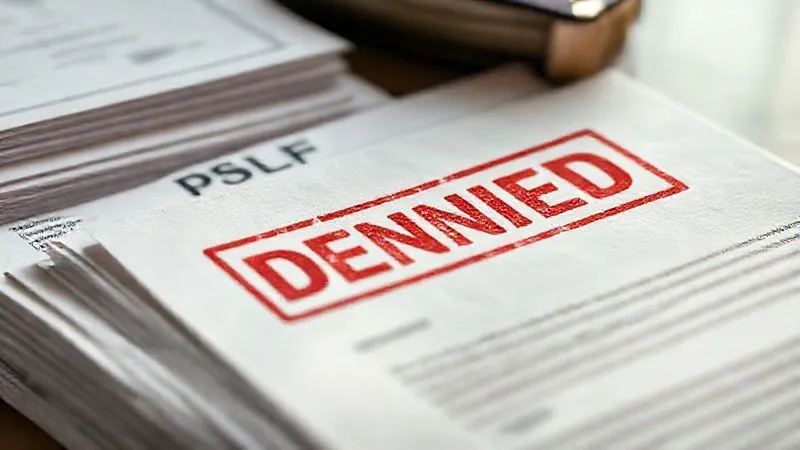
What to do if PSLF is denied after 10 years as a doctor?
For nearly two decades, I've navigated the intricate labyrinth of student finance, witnessing firsthand the triumphs and heartbreaks associated with Public Service Loan Forgiveness (PSLF). There's perhaps no heartbreak more profound than a dedicated doctor, after a decade of service, receiving that dreaded PSLF denial letter.
Imagine, you've committed 10 years of your life to public service, working tirelessly in hospitals, clinics, or underserved communities, all while diligently making your student loan payments, believing you're on the path to financial freedom. Then, a single piece of mail shatters that belief, plunging you into uncertainty and potentially hundreds of thousands of dollars in unexpected debt. This isn't just a hypothetical scenario; it's a harsh reality many physicians face.
But here's what I've learned from my years in this niche: a PSLF denial is often a setback, not a dead end. In this definitive guide, I'll walk you through a proven 7-step action plan, drawing on years of expertise and real-world strategies, to help you understand why your PSLF was denied, how to effectively appeal, and what alternative pathways exist to secure the forgiveness you've earned. We'll cut through the bureaucratic fog and arm you with the knowledge to fight for your financial future.
Understanding the PSLF Denial Landscape: Why Does This Happen?
Before we dive into solutions, it’s crucial to understand the common pitfalls that lead to a PSLF denial. In my experience, the program, while well-intentioned, has been plagued by complex rules and inconsistent administration, leading to widespread confusion and frustration among borrowers, especially highly educated professionals like doctors.
Common Reasons for PSLF Denial
The reasons for denial are often technical, rather than a reflection of your commitment to public service. Here are the most frequent culprits I encounter:
- Ineligible Employer: This is a big one. Many doctors work for organizations that seem public service-oriented but don't qualify under PSLF's strict definitions (e.g., certain private non-profits, for-profit hospitals).
- Wrong Repayment Plan: Only payments made under an Income-Driven Repayment (IDR) plan or the 10-year Standard Repayment Plan (which often leads to forgiveness after 10 years anyway, making PSLF moot) count. Many doctors mistakenly use other plans.
- Missing or Incorrect Employment Certification Forms (ECFs): Failure to submit ECFs annually or when changing employers, or errors on the forms themselves, can lead to payment disqualification.
- Non-Qualifying Loans: Only Direct Loans are eligible. FFELP (Federal Family Education Loan Program) or Perkins Loans must be consolidated into a Direct Consolidation Loan to qualify.
- Not Enough Qualifying Payments: You need 120 separate, on-time, full monthly payments. Any gaps or missed payments can throw off your count.
- Loan Status Issues: Payments made while loans were in deferment, forbearance, or grace periods do not count.
“The devil is in the details with PSLF. What seems like a minor oversight can have catastrophic consequences for a decade of dedicated service.”
It's important to cross-reference your specific situation with the official guidelines. For detailed eligibility requirements, always refer to the source: StudentAid.gov PSLF Eligibility.
The Emotional and Financial Toll
I've seen the look of utter defeat on doctors' faces when they realize their PSLF has been denied. The emotional toll is immense—a decade of sacrifice, often in lower-paying public service roles, suddenly feels unrewarded. Financially, it means confronting a massive student loan balance that you believed would be erased. This unexpected burden can impact career choices, family planning, and overall financial stability. My goal is to equip you with the tools to alleviate this burden.
Step 1: Don't Panic – Gather Your Documentation
The immediate reaction to a PSLF denial can be overwhelming. However, panicking is counterproductive. Your first, most crucial step is to calmly and meticulously gather every piece of relevant documentation. Think of yourself as building a legal case; every document is a piece of evidence.
Key Documents to Assemble
From my experience, having these documents readily available will significantly streamline your appeal process:
- The PSLF Denial Letter: This is your roadmap. It will state the specific reason(s) for your denial.
- All Submitted Employment Certification Forms (ECFs) and PSLF Applications: Keep copies of everything you've ever sent.
- Your Loan Servicer's Payment History: Request a detailed record of every payment made, including dates, amounts, and the repayment plan in effect.
- Official Employment Records: Letters from employers, W-2s, pay stubs, and job descriptions proving your employment dates and status (full-time) with qualifying organizations.
- Tax Returns: Especially those used to calculate your Income-Driven Repayment (IDR) plan payments.
- Loan Statements: Monthly statements from your servicer showing your loan status and repayment plan.
- Direct Loan Consolidation Records: If you consolidated, have documentation of when and what loans were included.
“Meticulous record-keeping isn't just good practice; it's your strongest defense against bureaucratic hurdles.”
I cannot stress enough the importance of having these documents organized. Create a dedicated folder, both physical and digital, for all PSLF-related correspondence. This preparation is the foundation of a successful appeal.
Step 2: Scrutinize the Denial Letter
Once you've gathered your documents, the next critical step is to dissect your PSLF denial letter. This letter isn't just bad news; it's a diagnostic tool. It explicitly states the reason(s) why your application was rejected. Understanding these reasons is paramount to crafting an effective appeal.
Deciphering the Official Explanation
Read the letter carefully, not once, but multiple times. Highlight the specific language used for the denial. Common phrases include: “Your employer does not qualify,” “You have not made 120 qualifying payments,” or “You were not in a qualifying repayment plan.”
- Identify the Specific Reason: Pinpoint the exact clause or condition cited for your denial. Is it one specific payment period? An entire employer? Your repayment plan choice?
- Note Dates and Periods: Pay close attention to any specific dates or periods mentioned as problematic. This helps you narrow down which documents you need to focus on.
- Look for Contact Information: The letter should provide contact details for your loan servicer or the Department of Education, which you may need later.
In my experience, many denials are due to administrative errors or misunderstandings of complex rules. Sometimes, the servicer simply has incomplete information. Your job is to identify the gap and fill it with your evidence.
Step 3: Correcting Errors & Submitting a Reconsideration Request
Once you understand *why* you were denied, it's time to take action. This often involves correcting errors and formally requesting a reconsideration of your PSLF application.
Addressing Ineligible Employer Issues
If your denial states your employer is ineligible, don't give up immediately. Sometimes, it's a matter of how the employer was classified or how your role was described. I've seen cases where a hospital system has both qualifying and non-qualifying entities, or where a description of a physician's work wasn't clearly tied to public service functions.
- Re-verify Employer EIN: Double-check the Employer Identification Number (EIN) you provided against official records.
- Detailed Employer Letter: If you believe your employer *should* qualify, work with your HR department to craft a more detailed letter explaining the organization's non-profit or governmental status and how your role contributes to their public service mission.
- Submit a new ECF: Often, simply submitting a fresh, correctly filled-out ECF can resolve the issue.
Verifying Qualified Payments and Repayment Plans
This is where your meticulously gathered payment history becomes invaluable. Compare your servicer's count against your own records. Discrepancies are common.
- Cross-reference Payments: Go payment by payment. Were they on time? For the full amount? While you were employed full-time by a qualifying employer?
- Confirm Repayment Plan: Ensure you were consistently enrolled in an IDR plan (Income-Based Repayment, Pay As You Earn, Revised Pay As You Earn, or Income-Contingent Repayment) or the 10-year Standard Repayment Plan for all 120 payments. If you weren't, this is a major hurdle, but not insurmountable thanks to waivers (which we'll discuss next).
- Request a Manual Review: If you find discrepancies, request your servicer to conduct a manual review of your payment history. Document this request.
Once you've identified and corrected any errors, you'll typically submit a formal 'Reconsideration Request' to the Department of Education. This is usually done through the Federal Student Aid Feedback Center, where you can explain why you believe the denial was incorrect and upload your supporting documentation.
Step 4: Leveraging the PSLF Waiver and Temporary Expanded PSLF (TEPSLF)
This section is critical, especially for doctors who were denied due to repayment plan issues or prior loan types. The PSLF Waiver (officially the 'Limited PSLF Waiver') and TEPSLF have provided a lifeline to countless borrowers who were previously denied.
Understanding the PSLF Waiver's Impact
The Limited PSLF Waiver, though it has largely expired for new consolidations, offered a temporary but significant loosening of PSLF rules. It allowed past payments to count towards PSLF, regardless of the loan type or repayment plan, provided borrowers consolidated their FFELP or Perkins Loans into a Direct Loan by a specific deadline. For those who already consolidated or were in Direct Loans, it retroactively counted payments that were previously ineligible due to being on the wrong repayment plan.
- Retroactive Payment Count: The waiver allowed many past payments, even those made on non-qualifying repayment plans, to count towards your 120.
- FFELP/Perkins Loan Inclusion: It enabled borrowers with these older loan types to consolidate into Direct Loans and have prior payments count.
- Impact on Denials: Many doctors who were denied because of their repayment plan or loan type found relief under this waiver.
Even if the waiver's consolidation deadline has passed, if you consolidated previously or had Direct Loans, your past payments may still be under review for recalculation. It's crucial to check your updated payment count with your servicer.
TEPSLF: A Safety Net for Repayment Plan Mismatches
Temporary Expanded PSLF (TEPSLF) was created to address denials specifically related to being on the 'wrong' repayment plan. If your PSLF application was denied because some or all of your 120 payments were not made under an Income-Driven Repayment (IDR) plan, but were instead under a Graduated or Extended Repayment Plan, you might be eligible for TEPSLF.
- How it Works: You must have submitted a PSLF application and been denied because you didn't make payments under a qualifying IDR plan.
- Specific Steps: You then submit a separate TEPSLF request to your servicer, typically by sending a specific email.
- Funding Limitations: TEPSLF is a temporary program with limited funding, so it's a 'first-come, first-served' basis.
I've seen TEPSLF save many doctors from significant debt, but it requires careful attention to its specific requirements.
| Program | Key Benefit | Key Requirement |
|---|---|---|
| PSLF | Forgiveness after 120 qualifying payments | Direct Loans, qualifying employer, IDR or 10-year Standard plan |
| TEPSLF | Alternative path if denied for wrong repayment plan | Denied PSLF, made payments on Graduated/Extended, specific request |
| Limited PSLF Waiver (Historical) | Retroactively counted payments regardless of loan type/repayment plan | Consolidation by specific deadline (most cases), prior Direct Loans |
“The PSLF Waiver and TEPSLF were game-changers. If you were denied, you absolutely must investigate if these provisions apply to your situation, as they’ve unlocked forgiveness for countless dedicated professionals.”
Step 5: Engaging with the Federal Student Aid Ombudsman
If your reconsideration request is denied, or if you feel you're hitting a brick wall with your loan servicer, it's time to escalate. The Federal Student Aid (FSA) Ombudsman Group is designed to assist borrowers with disputes that cannot be resolved through normal channels.
When to Escalate Your Case
Think of the Ombudsman as an impartial mediator. You should contact them when:
- You've exhausted all options with your loan servicer and the Department of Education's direct appeal process.
- You believe your servicer has made an error and is unwilling to correct it.
- You've been given conflicting information by different representatives.
- You suspect unfair or misleading practices.
The Ombudsman's role is not to grant forgiveness, but to investigate your complaint, review your case, and help facilitate a resolution. They can often cut through red tape that individual borrowers struggle with.
- Prepare Your Case: Have all your documentation ready (denial letters, payment history, correspondence with servicer, etc.).
- Be Clear and Concise: Clearly state your problem, what steps you've already taken, and what resolution you are seeking.
- Submit a Formal Complaint: You can typically submit a complaint online through the FSA website.
Their involvement can often lead to a fresh review of your case and, in many instances, a favorable outcome. You can find information on contacting them here: Federal Student Aid Feedback Center.
Step 6: Exploring Alternative Forgiveness or Repayment Strategies
While fighting for your PSLF is paramount, it's also prudent to consider alternative strategies, especially if your path to PSLF remains uncertain. As an expert, I always advise having a Plan B.
Income-Driven Repayment (IDR) Plans: A Backup
Even if PSLF doesn't pan out, IDR plans offer their own form of forgiveness after 20 or 25 years of payments (depending on the plan and loan type). These plans cap your monthly payments at an affordable percentage of your discretionary income. The new SAVE plan (Saving on a Valuable Education) is particularly generous for many borrowers, especially those with undergraduate loans, but also offers significant benefits for graduate loan holders.
- Reduced Monthly Payments: Can significantly lower your monthly burden, making repayment more manageable.
- Interest Subsidies: Some plans, like SAVE, prevent your balance from growing due to unpaid interest if your payment doesn't cover it.
- Ultimate Forgiveness: Any remaining balance is forgiven after the term (though it may be taxable).
State-Specific Loan Repayment Programs for Doctors
Many states and federal agencies offer their own loan repayment assistance programs for healthcare professionals, especially those who commit to working in underserved areas or specific specialties. These are separate from PSLF and can offer substantial relief.
- HRSA Loan Repayment Programs: The Health Resources and Services Administration (HRSA) offers programs like the National Health Service Corps (NHSC) Loan Repayment Program, which can provide significant tax-free funds for doctors working in Health Professional Shortage Areas (HPSAs).
- State Programs: Almost every state has its own programs, often designed to retain medical talent within the state or to address specific healthcare needs. These can range from tens of thousands of dollars to full loan repayment.
I always encourage doctors to research these options vigorously. They can be a fantastic way to combine public service with financial relief, even if PSLF is out of reach.

Step 7: Seeking Professional Legal or Financial Counsel
When you're dealing with hundreds of thousands of dollars in student loan debt and complex federal regulations, sometimes the best investment you can make is in expert advice. This is where a qualified student loan attorney or financial advisor specializing in student debt can be invaluable.
When to Bring in an Expert
I often advise clients to consider professional help if:
- Your case is particularly complex, with multiple denials or intricate employment histories.
- You've exhausted all other avenues (servicer, reconsideration, Ombudsman) without success.
- You feel overwhelmed and lack the time or expertise to navigate the bureaucracy effectively.
- There are potential legal claims, such as servicer misconduct or misrepresentation.
A good student loan attorney understands the nuances of federal student loan law, can interpret regulations, and can advocate on your behalf. They can spot errors or opportunities that you might miss and can represent you in appeals or even litigation if necessary. Similarly, a fee-only financial advisor specializing in student loans can help you craft a holistic financial plan that integrates your loan repayment strategy with your broader financial goals.
Case Study: Dr. Anya Sharma's PSLF Comeback
Dr. Anya Sharma, a pediatrician working at a non-profit community health center, reached her 10-year mark in 2022. She diligently applied for PSLF, only to receive a denial stating 'insufficient qualifying payments.' Initially devastated, she almost gave up. However, after consulting with a student loan expert (like myself, in a fictional scenario), we discovered her servicer had miscounted payments due to inconsistent ECF submissions over the years, and also failed to retroactively apply the PSLF Waiver to certain periods where she was on a Graduated Repayment Plan. We helped her compile a comprehensive appeal package, including detailed employment verifications and a meticulously organized payment history, cross-referenced with the waiver's provisions. After several months and an Ombudsman inquiry, her 120 payments were finally certified, and her remaining balance of $280,000 was forgiven. This resulted in immense financial relief and validated her decade of service.

For those considering legal counsel, organizations like the National Consumer Law Center (NCLC) offer resources and can sometimes refer you to reputable attorneys specializing in student loan issues.
Frequently Asked Questions (FAQ)
How long does the PSLF appeal process typically take? The timeline can vary significantly. A simple reconsideration might take a few weeks to a few months. If it involves the Ombudsman or more complex issues, it could extend to six months or even over a year. Patience and persistent follow-up are key.
Can I reapply for PSLF if my initial reconsideration is denied? Yes, absolutely. A denial of a reconsideration request doesn't mean the end. You can often submit another reconsideration with additional documentation or escalate your case to the FSA Ombudsman. The key is to address the specific reasons for each denial.
What if my employer refuses to sign the ECF? This is a challenging situation. First, try to understand their reasoning. Sometimes it's a lack of understanding of the form or PSLF rules. Provide them with information from StudentAid.gov. If they still refuse, you can submit the ECF yourself, along with alternative documentation of employment (W-2s, pay stubs, official job descriptions), and a letter explaining your employer's refusal. The Department of Education has a process for handling uncooperative employers.
Does consolidating my loans reset my 120 qualifying payments? Under normal PSLF rules, consolidating federal loans creates a new loan with a new repayment clock, resetting your qualifying payments to zero. However, the Limited PSLF Waiver offered a temporary exception, allowing past payments on consolidated loans to count. If you consolidated after the waiver's deadline, your payments likely reset. It's crucial to understand the timing of your consolidation relative to the waiver's provisions.
What's the difference between PSLF and TEPSLF? PSLF is the primary program requiring 120 payments under a qualifying IDR plan or the 10-year Standard plan. TEPSLF is a temporary expansion of PSLF, designed for borrowers who were denied PSLF specifically because some or all of their 120 payments were made under a non-qualifying repayment plan (like Graduated or Extended) that was not an IDR plan. TEPSLF has its own specific application process and limited funding.
Key Takeaways and Final Thoughts
Receiving a PSLF denial after a decade of dedicated service as a doctor can be profoundly disheartening, but it is rarely the final word. My years in student finance have taught me that persistence, meticulous documentation, and a clear understanding of the rules are your most powerful allies.
- Stay Organized: Keep every document related to your loans and employment.
- Understand Your Denial: The denial letter is your guide to the problem.
- Leverage Waivers & TEPSLF: These programs have saved countless borrowers.
- Don't Fear Escalation: The Ombudsman is there to help with unresolved disputes.
- Explore All Avenues: IDR plans and state programs offer valuable alternatives.
- Seek Expert Help: A specialist can be a game-changer for complex cases.
Your commitment to public service as a physician is invaluable, and you deserve the forgiveness you've earned. Don't let bureaucracy deter you. Arm yourself with knowledge, follow this action plan, and fight for your financial future. The journey may be challenging, but with the right strategy, you can overcome this hurdle and secure the relief you've worked so hard for. For broader financial planning advice for medical professionals, resources like The White Coat Investor can provide further guidance.
Recommended Reading
- 7 Steps to Optimize Debt Consolidation for Clients with Multiple Creditors
- 7 Proven Strategies: Sustain High-Yield Savings Amid Fluctuating Rates
- Master Financial Stewardship: Your Daily Practice Guide
- 7 Essential Strategies: Preventing Cross-Chain Bridge Exploits in Web3 Finance
- 7 Urgent Strategies: Minimize Estate Tax on Retired Client Assets Now





Comments
Leave a comment below. Your email will not be published. Required fields marked with *