


How to Optimize Emergency Fund for Volatile Professional Income?
For over two decades in the finance industry, I've had a front-row seat to the evolving landscape of professional income. I've witnessed countless individuals, from seasoned consultants to burgeoning entrepreneurs and gig-economy trailblazers, navigate the exhilarating highs and often terrifying lows of volatile earnings. One of the most common, yet critical, missteps I've observed is the application of traditional emergency fund advice to non-traditional income streams.
The standard recommendation of 3-6 months' worth of expenses, while sound for steady paychecks, often falls dangerously short for those whose income fluctuates wildly. This disconnect leaves many feeling perpetually anxious, struggling to build true financial resilience, and susceptible to the whims of an unpredictable market. It's a problem that can erode confidence, stifle growth, and even derail promising careers.
Today, I'm going to share a definitive framework – born from years of experience and refined through countless client interactions – on how to optimize emergency fund for volatile professional income. We'll move beyond generic advice to explore actionable strategies, tiered approaches, smart investment considerations, and the crucial mindset shifts necessary to build a robust financial safety net that truly serves your unique professional journey.
Understanding the Unique Challenge of Volatile Income
The very nature of volatile income presents a distinct set of financial planning hurdles that a salaried employee rarely encounters. One month might bring a windfall, while the next could be a barren desert, leaving you constantly guessing and often stressed. This unpredictability isn't just an inconvenience; it's a fundamental challenge to the core principle of an emergency fund: predictable security.
Traditional financial planning often assumes a steady income stream, making it easier to project savings, expenses, and investment timelines. When your income varies significantly, every projection becomes an educated guess, and the psychological burden can be immense. It's not just about covering unexpected bills; it's about bridging those inevitable income gaps, navigating slower periods, and having the peace of mind to focus on your work without constant financial dread.
The biggest mistake I see professionals with volatile income make is treating their emergency fund like a 'nice-to-have' instead of a strategic, foundational pillar. It's your personal economic stabilizer, not just a rainy-day jar.
Moreover, volatile income often comes hand-in-hand with self-employment or contract work, meaning you're also responsible for your own benefits, taxes, and business expenses. This layers on additional complexity, making a truly robust emergency fund not just advisable, but absolutely essential for long-term survival and prosperity.
Step 1: Redefining Your Emergency Fund Target
Let's be blunt: if your income is volatile, the standard 3-6 months of expenses is likely insufficient. I've seen this mistake countless times, where a sudden dip in client work or a delayed payment leaves individuals scrambling, even with a seemingly 'adequate' fund. Your target needs to reflect the reality of your income pattern and your personal risk tolerance.
Calculating Your "Comfort Zone" Buffer
Instead of a fixed number, I advocate for a "comfort zone" buffer. This is a more dynamic calculation that accounts for your fixed expenses, variable expenses, and the historical volatility of your income. You need to look at your income over a longer period – at least 12-24 months – to identify your lowest earning periods and average monthly income.
- Fixed Expenses: Rent/mortgage, insurance premiums, loan payments, subscriptions. These are non-negotiable.
- Variable Expenses: Groceries, utilities, transportation, entertainment. These can be adjusted, but a baseline is needed.
- Business Expenses: If self-employed, factor in software, tools, professional development, and marketing costs.
- Income Volatility Percentage: Calculate the difference between your highest and lowest monthly income over the past year or two. This percentage helps you understand the potential 'swing' you need to absorb.
- Personal Risk Tolerance: Are you comfortable with a tighter buffer, or do you prefer a larger cushion for peace of mind? This is subjective but crucial.
Once you have these figures, aim for a fund that covers your *essential* expenses for at least 9-12 months, and often up to 18-24 months for highly unpredictable sectors. This extended runway provides the necessary breathing room during prolonged dry spells or unexpected market shifts.
| Month | Income | Expenses |
|---|---|---|
| Jan | $4,500 | $3,000 |
| Feb | $3,200 | $3,000 |
| Mar | $6,800 | $3,000 |
| Apr | $2,800 | $3,000 |
| May | $5,500 | $3,000 |
| Jun | $3,000 | $3,000 |
For a deeper dive into calculating your personal financial runway, I recommend exploring resources like Investopedia's guide on personal runway, which offers valuable perspectives on extending your financial safety net.
Step 2: The Tiered Emergency Fund Approach
Building a massive single emergency fund can feel daunting and often inefficient. My preferred strategy, especially for those with volatile income, is a tiered approach. This method optimizes both liquidity and growth potential, ensuring you have immediate access to funds while also allowing a portion of your reserves to work harder for you.
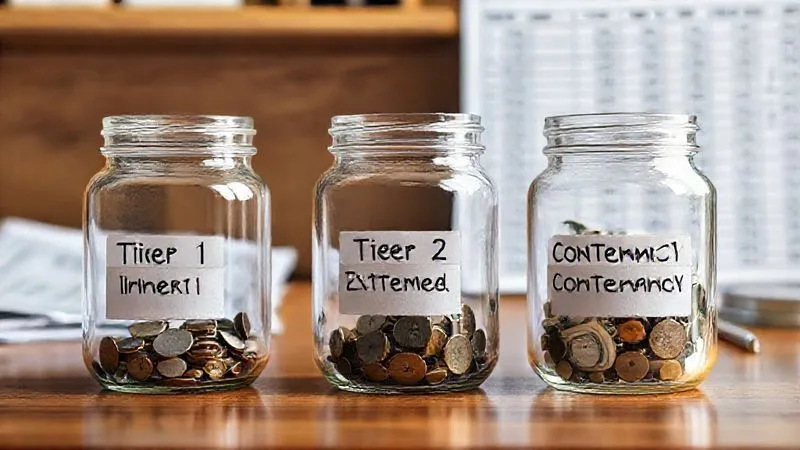
Tier 1: Immediate Liquidity (3-6 Months Core Expenses)
This is your traditional, easily accessible emergency fund. It should cover your absolute essential living expenses for 3 to 6 months. Think of it as your first line of defense against minor income dips or unexpected small expenses. The key here is immediate access and zero risk of capital loss.
- Where to keep it: High-Yield Savings Accounts (HYSAs), money market accounts, or a separate checking account.
- Purpose: Covering rent, utilities, basic food, and immediate unexpected costs like a car repair or medical deductible.
- Accessibility: Should be available within 24-48 hours.
Tier 2: Extended Buffer (6-12 Months for Income Gaps)
This tier is specifically designed to bridge those longer, more significant income gaps that are common with volatile earnings. It's your strategic reserve for when a major contract ends, a project is delayed, or a slow season extends longer than anticipated. While still liquid, it can afford slightly less immediate access than Tier 1.
- Where to keep it: Short-term Certificates of Deposit (CDs) that mature in 3-12 months, low-volatility bond ETFs, or even another HYSA that you don't touch for daily expenses.
- Purpose: Sustaining your lifestyle during prolonged periods of low or no income, giving you time to find new work or pivot your business.
- Accessibility: Accessible within a few days to a week, potentially with minor penalties for early withdrawal (which should be factored in).
Tier 3: Opportunity/Contingency Fund (Beyond 12 Months)
This tier moves beyond basic emergency coverage and serves a dual purpose: a deeper contingency for extreme circumstances (e.g., a major health crisis, prolonged economic downturn) and a strategic fund for seizing opportunities. This is where your money can start to work harder for you, as the liquidity requirements are less stringent.
- Where to keep it: A diversified portfolio of conservative investments, such as a mix of short-term bond funds, index funds, or even real estate (if it aligns with your long-term goals and risk tolerance).
- Purpose: Providing an ultimate safety net, funding professional development, investing in new business ventures, or making a down payment on a home.
- Accessibility: Accessible within weeks to months, with potential for market fluctuations.
Step 3: Automating & Adapting Your Savings Strategy
The biggest challenge with volatile income is consistent saving. When money comes in irregularly, it's tempting to spend more during the good times and then regret it during the lean months. Automation and a flexible, percentage-based approach are your best friends here.
The "Income Percentage" Rule
Instead of a fixed dollar amount, commit to saving a specific percentage of *every* payment you receive. This ensures that when you have a high-income month, you save more, and during a lower-income month, you still contribute, albeit less. I've found that a range of 20-40% of gross income, dedicated solely to your emergency tiers, is a good starting point for many with volatile income, adjusting based on your expenses and income variability.
Automating Deposits During Peak Periods
Set up automatic transfers from your primary checking account to your Tier 1 and Tier 2 emergency funds immediately after receiving a large payment. Many banking apps allow you to schedule transfers that trigger upon a certain balance or on specific dates. Treat these transfers as non-negotiable expenses, just like your rent or mortgage.
Case Study: Maria's Seasonal Income Strategy
Maria, a freelance graphic designer, faced significant income fluctuations, earning substantially more during the holiday season and summer months. She struggled to maintain a consistent emergency fund. By implementing the "income percentage" rule, she committed to saving 30% of every invoice payment. During her peak months, this meant substantial transfers to her Tier 2 fund. In leaner periods, even a smaller percentage ensured she was still contributing. She also set up an automated rule to transfer an additional $500 to her Tier 1 fund on the 15th of every month, drawing from her main checking account. This dual approach – percentage-based for large inflows and fixed for consistency – allowed her to build a 12-month emergency buffer within two years, providing unprecedented peace of mind during her slow seasons.
Consistency, even in small amounts, is more powerful than sporadic, large contributions. Make saving for your future self a non-negotiable financial habit.
Step 4: Smart Investments for Your Emergency Tiers
While the primary goal of an emergency fund is safety and accessibility, for those with volatile income and larger reserves, it's crucial to optimize where these funds are held. Each tier has different liquidity needs, which should dictate its investment vehicle.
Tier 1: High-Yield Savings Accounts (HYSA) & Money Market Funds
For your immediate liquidity tier, HYSAs and money market accounts are ideal. They offer higher interest rates than traditional savings accounts while providing instant access to your funds. Look for institutions with no monthly fees and FDIC insurance.
- Pros: High liquidity, minimal risk, better returns than traditional savings.
- Cons: Returns are still relatively low, susceptible to inflation.
Tier 2: Short-Term CDs or Low-Volatility Bond ETFs
For your extended buffer, you can explore options that offer slightly better returns without sacrificing too much liquidity. Short-term CDs (e.g., 3, 6, or 12-month terms) can lock in a better rate, though you'll face penalties for early withdrawal. Low-volatility bond ETFs (e.g., short-term government bond ETFs) offer diversification and slightly better returns than HYSAs, with daily liquidity, but come with minimal market risk.
- Pros: Better returns than Tier 1, still relatively safe and accessible.
- Cons: CDs have early withdrawal penalties; bond ETFs have minor market risk.
Tier 3: Broader Diversification Considerations (if applicable)
For your deepest contingency fund, especially if it exceeds 12-18 months of expenses, you can consider more diversified, conservative investment strategies. This might include a mix of diversified index funds (e.g., total market or S&P 500 ETFs) or balanced mutual funds. The key here is to maintain a conservative allocation, as this is still a "contingency" fund, not your aggressive growth portfolio.
- Pros: Potential for higher long-term growth, combating inflation more effectively.
- Cons: Higher market risk, longer time horizon for access.
Remember, the goal is not aggressive growth for any emergency fund tier. Safety and accessibility always come first. For more detailed insights into conservative investment strategies, consider resources like Fidelity's guide on ETFs, which can help you understand these vehicles better.
Step 5: Integrating Risk Management & Income Diversification
An emergency fund is a reactive tool – it helps you *after* an income dip. True financial resilience for volatile income professionals also requires proactive risk management and income diversification. This is where you build a stronger financial foundation that reduces the likelihood of needing to lean heavily on your emergency fund.
Beyond the Fund: Building Multiple Income Streams
One of the most effective ways to mitigate income volatility is to diversify your income sources. Relying on a single client or project is inherently risky. Actively pursue multiple revenue streams:
- Multiple Clients: Spread your work across several clients rather than being overly dependent on one.
- Passive Income: Explore options like royalties, rental income, or even creating digital products that generate income passively.
- Complementary Services: Offer related services that can fill gaps during slower periods for your primary offering.
- Side Gigs: Maintain a small, consistent side gig that can provide a baseline income during very lean times.
Insurance as a Complementary Safety Net
Your emergency fund shouldn't be drained by insurable events. Proper insurance coverage acts as a critical complement to your cash reserves. Consider:
- Health Insurance: Essential for avoiding catastrophic medical bills.
- Disability Insurance: Replaces a portion of your income if you become unable to work due to illness or injury. This is particularly crucial for self-employed individuals.
- Professional Liability Insurance: Protects you from claims of negligence or errors in your professional services.
- Home/Renters Insurance: Protects your assets from fire, theft, and other perils.

By proactively diversifying your income and ensuring robust insurance coverage, you reduce the strain on your emergency fund, allowing it to truly serve its purpose for *unforeseen* income gaps, rather than predictable risks. For further reading on income diversification, Forbes offers excellent articles, such as this guide on building multiple income streams.
Step 6: Regular Review and Adjustment
Your financial situation isn't static, and neither should your emergency fund strategy be. I cannot stress enough the importance of regular review and adjustment, especially when dealing with volatile income. What worked last year might not be optimal this year.
The Quarterly Financial Health Check-up
At least once a quarter, carve out dedicated time for a comprehensive financial review. This isn't just about glancing at your bank balance; it's about a deep dive into your income, expenses, and savings strategy.
- Review Income History: Look at your income over the past 3-6 months. Are there new patterns? Has volatility increased or decreased?
- Audit Expenses: Have your fixed or variable expenses changed significantly? Are there areas where you can trim costs to free up more savings?
- Assess Fund Size: Based on current expenses and income volatility, is your emergency fund still adequate? Do you need to increase your target?
- Evaluate Investment Performance: For Tier 2 and Tier 3 funds, are your chosen vehicles performing as expected? Are they still aligned with your risk tolerance and liquidity needs?
- Update Goals: Have your personal or professional goals shifted? Does your emergency fund strategy need to adapt to support new aspirations (e.g., taking a sabbatical, investing in a new business venture)?
This regular check-up allows you to be agile and proactive, ensuring your emergency fund remains a robust and relevant safety net. It's a critical habit for anyone navigating the unpredictable waters of volatile professional income.
| Check-up Item | Status | Action Required |
|---|---|---|
| Income Analysis (Past 6 Months) | Complete | Identify peak/trough patterns |
| Expense Audit (Fixed & Variable) | Complete | Reduce non-essential variable costs |
| Emergency Fund Target Assessment | In Progress | Increase Tier 2 target by 1 month |
| Investment Vehicle Review (Tier 2/3) | Pending | Research new HYSA rates |
| Insurance Coverage Review | Complete | None |
| Income Diversification Strategy | In Progress | Pitch 2 new clients |
Avoiding Common Pitfalls with Volatile Income
Even with the best intentions, it's easy to fall into traps when managing finances with unpredictable earnings. Recognizing these common pitfalls can help you steer clear and maintain your financial stability.
- Underestimating Your Needs: The most prevalent mistake is assuming a traditional 3-6 month emergency fund will suffice. Always err on the side of caution and aim for a larger buffer.
- Ignoring the Psychological Impact: The stress of volatile income is real. Don't underestimate its effect on your decision-making. A robust emergency fund isn't just financial; it's mental health insurance.
- Over-investing for Growth: While it's tempting to chase higher returns, remember that the primary purpose of an emergency fund is capital preservation and liquidity. Don't put funds you might need in the short to medium term into high-risk investments.
- Failing to Adjust for Business Expenses: If you're self-employed, your emergency fund needs to cover not just personal living expenses but also critical business operating costs during lean times.
- Not Separating Personal and Business Finances: This is a recipe for disaster. Always keep your personal emergency fund distinct from your business operating capital.
- Ignoring Tax Implications: For self-employed individuals, a significant portion of income needs to be set aside for taxes. Don't mistake this for part of your emergency fund.
Patience and discipline are your most valuable assets when building financial security with volatile income. It's a marathon, not a sprint, and every consistent step forward makes you stronger.
Frequently Asked Questions (FAQ)
How much emergency fund is *really* enough for volatile income? In my experience, a minimum of 9-12 months of essential living expenses is a good starting point, with many professionals benefiting from 18-24 months, especially if their income swings are significant or their industry is prone to long dry spells. The tiered approach helps manage this larger sum effectively.
Can I invest my emergency fund for better returns? Only a portion, and only in very conservative, low-risk vehicles. Your Tier 1 (immediate liquidity) should be in HYSAs or money market accounts. Your Tier 2 and Tier 3 can explore short-term CDs or low-volatility bond ETFs, but never anything that risks your principal in the short to medium term. The primary goal is capital preservation and accessibility, not aggressive growth.
What if my income suddenly drops for a very long time, beyond my emergency fund? This is why a multi-pronged strategy is crucial. Your emergency fund buys you time. During that time, you should be actively pursuing new income streams, cutting non-essential expenses drastically, and leveraging your professional network. It's also why disability insurance (for health issues) and income diversification are so important.
How do I balance saving for an emergency fund with other financial goals like retirement or a down payment? Prioritization is key. Your emergency fund is foundational. I always advise clients to fully fund their Tier 1 and Tier 2 emergency funds before aggressively pursuing long-term investment goals. Once your core safety net is solid, you can allocate a portion of your income to other goals, maintaining the percentage-based saving approach.
Are there specific tools or apps that help manage volatile income and emergency funds? Absolutely. Budgeting apps like YNAB (You Need A Budget) or Mint can help track income and expenses. Tools like Personal Capital can give you a holistic view of your finances. For self-employed individuals, platforms like FreshBooks or QuickBooks Self-Employed can help manage invoices, expenses, and tax estimations, making it easier to identify funds available for your emergency savings. Automated transfer features offered by most banks are also invaluable.
Key Takeaways and Final Thoughts
Navigating professional life with volatile income demands a proactive, strategic approach to your emergency fund. It's not a luxury; it's the bedrock of your financial freedom and mental well-being. By adopting a mindset that embraces unpredictability and builds resilience, you can transform anxiety into empowerment.
- Redefine Your Target: Move beyond 3-6 months; aim for 9-24 months based on your unique volatility.
- Embrace Tiers: Segment your fund into immediate, extended, and contingency tiers for optimal management.
- Automate & Adapt: Use a percentage-based savings rule and automate deposits, especially during peak income periods.
- Invest Smart: Match investment vehicles to each tier's liquidity needs, prioritizing safety over aggressive returns.
- Diversify Income & Insure Risks: Proactively build multiple income streams and ensure robust insurance coverage to reduce reliance on your fund.
- Review Regularly: Your strategy isn't static; conduct quarterly check-ups to adjust to changing circumstances.

Building an optimized emergency fund for volatile income is a journey, not a destination. It requires discipline, foresight, and a willingness to adapt. But the peace of mind, the freedom to pursue opportunities, and the resilience it provides are immeasurable. Take these strategies, tailor them to your unique situation, and embark on the path to true financial security. Your future self will thank you for it.
Recommended Reading
- Career Setback? 7 Steps to Rapidly Restore Emergency Cash Reserves
- Mastering Lifestyle Creep: 7 Strategies for Professional Financial Freedom
- Unlock Financial Freedom: How to Build a Monthly Budget for Variable Income
- Unlock Budget Travel: How to Create a Financial Plan That Works
- 7 Steps: How to Responsibly Consolidate Business Debt & Avoid Over-Leveraging





Comments
Leave a comment below. Your email will not be published. Required fields marked with *