



How to Legally Reduce Retirement Income Tax Burden Post-65?
For over two decades in the financial planning trenches, specializing in retirement strategies, I've witnessed a common, often painful, realization among many clients: the joy of retirement can be significantly dampened by an unexpected and persistent guest – income taxes. It's a scenario I've seen play out countless times: individuals meticulously save for decades, only to find a substantial portion of their hard-earned nest egg being siphoned off by taxes once they hit their golden years, especially after the age of 65 when new rules like Required Minimum Distributions (RMDs) kick in.
The pain point is palpable. Many retirees, having moved past the high-earning years, expect their tax burden to diminish. Instead, they face a complex web of Social Security taxation, pension income, 401(k) and IRA distributions, and investment gains, all contributing to a higher-than-anticipated tax bill. This can erode spending power, impact legacy planning, and create unnecessary financial stress during a time that should be about relaxation and enjoyment.
But here's the good news: it doesn't have to be this way. In this definitive guide, I'm going to share with you proven, legal, and actionable strategies that I've helped countless clients implement to significantly reduce their retirement income tax burden post-65. We'll delve into frameworks, real-world applications, and expert insights designed to empower you to keep more of your money, where it belongs – with you.
Understanding the Post-65 Tax Landscape: More Than Just Social Security
Before we dive into solutions, it's crucial to understand the terrain. Once you cross the 65-year mark, your income sources typically diversify, and so do the tax implications. You're likely drawing from a mix of Social Security benefits, pension payouts, distributions from traditional IRAs and 401(k)s, and perhaps income from taxable investment accounts.
Each of these income streams is treated differently by the IRS. For instance, a portion of your Social Security benefits might become taxable depending on your 'provisional income.' Distributions from traditional pre-tax retirement accounts are generally taxed as ordinary income. Even seemingly simple investment gains can trigger capital gains taxes. The cumulative effect can push you into a higher tax bracket than you anticipate, especially when Required Minimum Distributions (RMDs) start at age 73 (or 75 for those born in 1960 or later), forcing you to withdraw money whether you need it or not.
Expert Insight: Proactive tax planning in retirement isn't about avoiding taxes; it's about optimizing your financial decisions within the legal framework to minimize your tax liability. It's about strategic distribution, not just accumulation.
Strategic RMD Management: The Qualified Charitable Distribution (QCD) Power Play
One of the most powerful tools for individuals subject to RMDs, particularly after age 70.5, is the Qualified Charitable Distribution (QCD). This strategy allows you to satisfy your RMD without the distribution being included in your taxable income.
How QCDs Work to Reduce Your Tax Burden
- Identify Your RMD: First, determine your Required Minimum Distribution for the year from your traditional IRAs.
- Choose a Qualified Charity: Select a 501(c)(3) public charity. The funds must go directly to the charity.
- Direct Transfer: Instruct your IRA custodian to directly transfer funds from your IRA to the chosen charity. You cannot take the distribution yourself and then donate it; it must be a direct transfer.
- Limit: You can transfer up to $105,000 per year (indexed for inflation) as a QCD.
- Tax Benefit: The amount transferred as a QCD counts towards your RMD but is excluded from your gross income, thus reducing your taxable income for the year.
This is particularly beneficial because it reduces your Adjusted Gross Income (AGI), which can have a ripple effect, potentially lowering the taxation of your Social Security benefits, reducing Medicare Part B and D premiums (IRMAA surcharges), and increasing your eligibility for other tax credits and deductions.

Health Savings Accounts (HSAs): The Triple-Tax Advantage in Retirement
While often thought of as a pre-retirement tool, the Health Savings Account (HSA) truly shines in retirement, particularly after age 65. If you've been fortunate enough to contribute to an HSA while eligible (enrolled in a high-deductible health plan), you've been building a powerful tax-advantaged vehicle for future medical expenses.
Maximizing HSA for Future Medical Costs Post-65
HSAs boast a unique 'triple-tax advantage':
- Tax-Deductible Contributions: Contributions are made pre-tax (or are tax-deductible if made post-tax).
- Tax-Free Growth: Funds grow tax-free.
- Tax-Free Withdrawals: Withdrawals for qualified medical expenses are tax-free.
Once you enroll in Medicare (typically at 65), you can no longer contribute to an HSA. However, you can continue to use the funds tax-free for qualified medical expenses, which can be substantial in retirement. This includes Medicare Part A, B, C, and D premiums (excluding Medigap), prescription drugs, dental, vision, and long-term care insurance premiums. This means you can effectively pay for many of your healthcare costs with funds that have never been taxed.
Expert Insight: Many financial planners advocate treating your HSA as a 'stealth IRA' for retirement healthcare. If you can afford to pay for current medical expenses out-of-pocket, letting your HSA grow untouched for decades can provide an immense tax-free pool for future, potentially large, medical costs.
For detailed information on qualified medical expenses, refer to IRS Publication 502.
Tax-Loss Harvesting and Investment Portfolio Optimization
For retirees with taxable investment accounts (non-retirement accounts), tax-loss harvesting is a fundamental strategy to legally reduce your tax burden. This involves selling investments at a loss to offset capital gains and, in some cases, a limited amount of ordinary income.
Case Study: The Market Downturn Advantage for Sarah
Sarah, a 72-year-old retiree, had a diversified taxable brokerage account. In a volatile year, she realized $15,000 in long-term capital gains from selling some appreciated tech stocks. However, she also held several mutual funds that had underperformed, sitting on unrealized losses. By strategically selling $20,000 worth of these underperforming funds, she generated a capital loss of $20,000. She used this loss to offset her $15,000 capital gain entirely, resulting in no capital gains tax for the year. Furthermore, she had a remaining $5,000 capital loss. She was able to deduct $3,000 of this against her ordinary income, reducing her overall taxable income, and carried forward the remaining $2,000 loss to future tax years. This maneuver saved her hundreds, if not thousands, in taxes.
| Action | Amount |
|---|---|
| Realized Capital Gains | $15,000 |
| Realized Capital Losses (Tax-Loss Harvesting) | -$20,000 |
| Net Capital Gain/Loss | -$5,000 |
| Offset Capital Gains | -$15,000 |
| Deductible Against Ordinary Income | -$3,000 |
| Loss Carried Forward | -$2,000 |
This strategy is particularly effective during market downturns, allowing you to turn temporary paper losses into tangible tax savings. Just be mindful of the 'wash-sale rule,' which prohibits buying substantially identical securities within 30 days before or after the sale.
Location, Location, Location: State Income Tax Considerations
While often a significant life decision, changing your state of residence can be a powerful lever to reduce your state income tax burden in retirement. Many states offer favorable tax environments for retirees, particularly concerning retirement income.
States with Favorable Retirement Tax Rules
As of my last update, several states do not levy a state income tax at all, including Alaska, Florida, Nevada, South Dakota, Texas, Washington, and Wyoming. Additionally, some states that do have income tax exempt specific types of retirement income, such as Social Security benefits, pension income, or even all retirement income.
- No State Income Tax: Moving to one of these states can eliminate a significant portion of your tax bill entirely.
- Retirement Income Exemptions: Other states might tax earned income but exempt Social Security, pensions, or IRA/401(k) distributions. For example, Pennsylvania generally exempts most retirement income from state taxation.
Before making a move, it's essential to research the full tax picture, including property taxes, sales taxes, and estate taxes, as these can vary widely and offset any income tax savings. A comprehensive guide to state tax on retirement income can be found on sites like Kiplinger or similar financial publications.
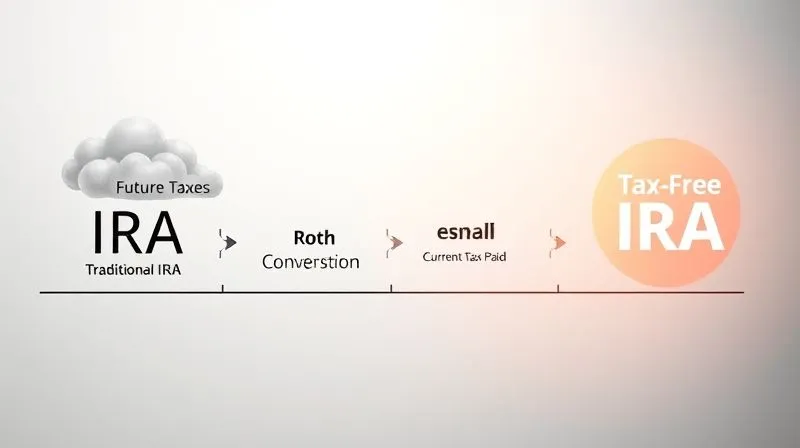
Roth Conversions: A Long-Term Bet Against Future Tax Hikes
Converting a traditional IRA or 401(k) to a Roth IRA involves paying taxes on the converted amount in the year of conversion. While this might seem counterintuitive for reducing your current tax burden, it's a strategic move to eliminate future tax liabilities, especially after age 65 when RMDs become a factor.
Strategic Timing and Incremental Conversions
The ideal time for a Roth conversion is typically during years when you anticipate being in a lower tax bracket. This could be:
- Early Retirement Before Social Security/RMDs: The years between retiring and starting Social Security or RMDs (ages 60-72) often present a 'taxable income gap' where your income might be lower.
- Market Downturns: If your traditional IRA's value has temporarily dropped, converting a portion now means you pay taxes on a lower amount, and future growth will be tax-free.
I often advise clients to consider incremental Roth conversions – converting smaller amounts over several years rather than a large lump sum. This allows you to manage the tax impact each year and stay within desired tax brackets. The beauty of a Roth IRA in retirement is that qualified distributions are entirely tax-free, and unlike traditional IRAs, Roth IRAs have no RMDs for the original owner, offering incredible flexibility and a powerful legacy planning tool.
Expert Insight: A Roth conversion is essentially a bet that your future tax rate will be higher than your current tax rate. Given the national debt and potential future policy changes, this is often a calculated and wise wager for long-term tax reduction.
Leveraging Tax Credits and Deductions for Seniors
Many retirees overlook available tax credits and deductions specifically designed for seniors or those with certain circumstances. These can directly reduce your taxable income or even your tax liability dollar-for-dollar.
Don't Overlook Small Opportunities
- Medical Expense Deduction: If your unreimbursed medical expenses exceed 7.5% of your Adjusted Gross Income (AGI), you can deduct the amount over that threshold. As medical costs often rise in retirement, this can be a significant deduction.
- Standard Deduction for Seniors: If you're 65 or older and/or blind, you get an additional standard deduction amount. If both spouses qualify, they both get the additional amount.
- Credit for the Elderly or the Disabled: This is a nonrefundable tax credit for low-income individuals who are 65 or older or retired on permanent and total disability. While it has income limitations, it can provide a direct tax reduction.
- State and Local Taxes (SALT) Deduction: While capped at $10,000, property taxes and state income/sales taxes can be deducted if you itemize.
- Charitable Contributions: Beyond QCDs, cash contributions to qualified charities can be deducted if you itemize, up to 60% of your AGI.
It's crucial to keep meticulous records of all potential deductions and credits. Often, a combination of these smaller items can add up to substantial savings. Consulting with a tax professional can help ensure you're not missing any opportunities.
Social Security Taxation: Understanding and Mitigation
One of the most common surprises for retirees is that their Social Security benefits can be taxed. The amount taxed depends on your 'provisional income,' which is calculated as your AGI + non-taxable interest + half of your Social Security benefits.
Strategies to Keep Provisional Income Lower
If your provisional income is between $25,000 and $34,000 for an individual ($32,000 and $44,000 for married filing jointly), up to 50% of your Social Security benefits may be taxable. If it exceeds these upper thresholds, up to 85% of your benefits may be taxable. This is often referred to as the 'tax torpedo' because a small increase in other income can trigger a disproportionately large increase in taxable Social Security benefits and thus your overall tax bill.
| Income Source | Example Value |
|---|---|
| Adjusted Gross Income (AGI) | $20,000 |
| Non-Taxable Interest | $1,000 |
| Half of Social Security Benefits | $8,000 |
| Provisional Income Calculation | AGI + Non-Taxable Interest + Half SS |
| Provisional Income Total | $29,000 |
| Taxable Social Security (Individual Threshold) | 50% (since PI > $25k and < $34k) |
Strategies that reduce your AGI, such as utilizing Qualified Charitable Distributions (QCDs) from your IRA, can directly lower your provisional income and potentially reduce the taxable portion of your Social Security benefits. Carefully managing distributions from traditional pre-tax accounts and considering Roth conversions in lower-income years can also help control your AGI and thus your provisional income.
Frequently Asked Questions (FAQ)
Question: Can I still contribute to an IRA after 70.5? Detailed answer: Yes, with the SECURE Act, the age limit for contributing to a traditional IRA was eliminated. As long as you have earned income, you can contribute to a traditional or Roth IRA, regardless of your age. This can be a valuable way to continue saving and potentially reducing your taxable income, depending on the type of IRA and your income level.
Question: How do RMDs affect Medicare premiums? Detailed answer: Your Required Minimum Distributions from traditional retirement accounts are considered taxable income and are included in your Adjusted Gross Income (AGI). Medicare Part B and Part D premiums are subject to the Income-Related Monthly Adjustment Amount (IRMAA). If your AGI crosses certain thresholds, your Medicare premiums can significantly increase. This is why managing your RMDs and AGI through strategies like QCDs is crucial to avoid higher healthcare costs.
Question: What's the 'tax torpedo' and how can I avoid it? Detailed answer: The 'tax torpedo' refers to the disproportionate increase in the taxable portion of your Social Security benefits as your provisional income rises. A small increase in other income can push you past a threshold, making 50% or even 85% of your Social Security taxable. To avoid it, focus on strategies that keep your AGI and provisional income lower, such as Qualified Charitable Distributions, strategic Roth conversions in low-income years, and carefully managing taxable investment income.
Question: Should I pay off my mortgage in retirement to reduce taxes? Detailed answer: While paying off your mortgage eliminates interest payments, which are a deduction if you itemize, the decision to pay it off early in retirement is complex. If you have significant cash in low-yielding accounts, using it to pay off a mortgage with a higher interest rate can be financially sound. However, if that cash is in tax-advantaged accounts like IRAs, withdrawing it might trigger a large taxable event. Also, having a paid-off home means less liquidity. It's a personal decision that should be weighed against your overall financial picture, liquidity needs, and other investment opportunities. It doesn't directly reduce income tax burden unless the interest deduction was a major factor in your itemized deductions.
Question: When should I seek professional tax advice? Detailed answer: I strongly recommend seeking professional tax advice whenever your financial situation becomes complex, you're considering major financial decisions (like Roth conversions, selling a business, or relocating), or if you simply feel overwhelmed by the tax code. A qualified financial advisor or CPA specializing in retirement planning can provide personalized strategies, ensure compliance, and help you uncover opportunities you might miss, ultimately saving you money and stress.
Key Takeaways and Final Thoughts
- Proactive tax planning is essential for a financially secure retirement post-65.
- Utilize Qualified Charitable Distributions (QCDs) to satisfy RMDs and reduce taxable income.
- Leverage Health Savings Accounts (HSAs) for tax-free medical expense payments.
- Implement tax-loss harvesting in taxable accounts to offset gains and ordinary income.
- Consider state income tax implications when choosing your retirement residence.
- Strategically time Roth conversions to pay taxes now and avoid them later, especially before RMDs begin.
- Don't overlook valuable tax credits and deductions available to seniors.
- Understand how your provisional income affects Social Security taxation and implement strategies to mitigate it.
Navigating the tax landscape in retirement can feel daunting, but with the right knowledge and strategic application, you absolutely can legally reduce your retirement income tax burden post-65. These aren't just theoretical concepts; they are practical, battle-tested strategies that have made a tangible difference for countless retirees. Take the time to understand your unique situation, apply these insights, and don't hesitate to seek professional guidance. Your future financial peace of mind is worth the effort.
Recommended Reading
- Unlock Your Crypto: How to Recover Lost Virtual Currency Wallet Access Now!
- Lost Funds? 7 Steps to Recover from Sophisticated Digital Payment Fraud
- The Ultimate Guide: How to Financially Prepare for Rental Property Vacancies
- ESG Investing: Is Paying Higher Fees Really Worth It?
- Unlock Tax Savings: Optimize Business Expenses with This Ultimate Guide




Comments
Leave a comment below. Your email will not be published. Required fields marked with *